Pages

Sunday, 30 December 2018

15 Years of Creativity in Glass; Retrospective of Works

Hello. Thanks for finding the time to take a look at my blog. I would like to offer you to visit my personal virtual exhibition dedicated to 15 years of my creativity in glass. I would like to introduce you to my art. I put together the best of my work to reflect the growth of my artistic mindset. You will see the source of my inspiration and the finished products. I hope you find it interesting and beautiful. 

15 years, I have worked with glass. 15 years of life, passion, rejection and tenderness. First I would like to present to you a piece that I finished in December 2018. Here you can see a fused panel of glass that is 6mm thick with a textured surface. The drawing is made with glass powder. This piece is titled Irises, inspired by Van Gogh. 29 x 35 cm. In the present, I think this is my best work with fusing. I developed the technique for drawing with glass powder and the story of it is here. 

Van Gogh was chosen as a source of inspiration due to the fact that he was bipolar. I was diagnosed with bipolar disorder in December 2014. Since then, I have been depressed for a four years. To my astonishment, I have come out of depression thanks to my Irises. I worked on drawing Irises for half a year when Van Gogh painted his in two days. The story of how my Irises came about is here. 

I spent 70 hours in total creating the Irises during the 6 months that I have worked on them. Not much in half a year, but that is just my tempo at the moment. Now my momentum will increase since I am in love with glass again. During these 6 months I have come from depression to be inspired all the time and to be constantly thinking about glass... I never expected this. This is the might of beauty and art therapy. 

“I put my heart and soul into my work” that I am now presenting to you (Van Gogh). 
 I will be presenting my work from the very beginning of my artistic career to present day. What made each work challenging? What did I learn through every piece? What was the source behind my inspiration? 

I am a self-taught artist having finished a two-day stained glass workshop in Calgary, Alberta, Canada way back in 2003. Since then my life has changed drastically with regards to the countries and cities I have lived in. I understand that there are people out there that have experienced a greater change, but this is a lot from my perspective in terms of creating, moving, recreating and moving my glass shop again. In the last 15 years, I have had eight different glass shops. And throughout all this I have been stubbornly working on my glass, living with my glass, dreaming of my glass and fanaticized over my glass. It is an obsession. At one point in time I thought that I was completely done with it, but now I am back! 

Back in 2003, after the two-day workshop, I instantly wanted to create a large stained glass piece to put into the library we had in our home. This piece had more than 200 pieces. An overwhelming task for a complete amateur. I altered the design of an elephant by adding a blanket and a hat to the original design and I was very proud of myself. 
In 2004, the Divine Beauty came about. Before its creation, I was looking at photos of hundreds of other stained glass works and saw one captured me with its lines and composition but not its colour scheme. 
Thus, I decided to change the colour and make some changes to the overall composition. After I finished this piece, I could not take my eyes away from it for hours on end. I could not believe that I was capable of creating something like this. What is interesting is that when our home caught fire in 2006, I later came back into our burnt house to find a melted wall, the window in the kitchen shattered, frost and snow behind the shattered window and my Divine Beauty hanging there without a scratch on it. 
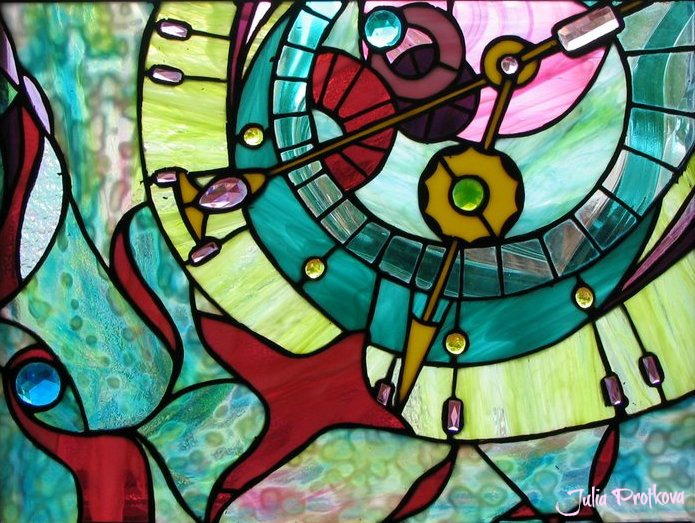
 In 2004, I heard music in the glass. One year after my work with glass I gained some insight. This feeling kept coming back to me throughout the years and I would constantly think about the music within the glass. This year, I created three stained glass pieces; though I had taken apart one of them and remake it since I was unhappy with my choice of colour. My source of inspiration for these three pieces was a drawing by my sister Galina Og. These three pieces together are called Musical Improvisations.
You will undoubtedly see a clock that gives off a rhythm. But I associate the colour of the glass to the waltz from the ballet of the Nutcracker by Tchaikovsky. This piece is called Winter Dream. 
 This piece is titled Jazz and sounds like Summertime by Ella Fitzgerald. 
 And finally Tango, a beautiful glass piece filled with passion. 
 In 2005, I made Scarlet Sails. I found a beautiful piece of glass in which I saw the sea, the sky and the sun.
 Everything that is necessary for a background. And I like sailing ships very much. Aside from this, I had wonderful glass to use for the scarlet sails. Respectively, I created my own design and so came about the Scarlet Sails which I put in our living room. At the same time, I was making many stained glass gifts for my many friends in Calgary.
 Towards the end of 2005, I decided that I would create my own rose window of my own design. I was studying symbolism and started to draw my own custom designs. At the same time, my calm life was falling apart around me. My home had already burnt down in January 2006, I had problems with my health and I was in the middle of a divorce... But I still continued to work on my glass. The Harmony of the World is a piece that was being designed and cut between 2006 and 2007 upon the remnants of my previous life in Calgary, but was only soldered and put together in Montreal where I moved in 2008 after living in New York for one year. The Harmony of the World was designed to be mounted as a “fireplace” and I spent many evenings in front of this piece. More information about The Harmony of the World can be read about here. What is Harmony for me? Whilst working on this piece, I knew that I wanted to become a glass artist and I am following this path since then. 
 Now we are in 2008. This year was a turning point for me because at the end of the year I finally decided that I have done enough research into fusing glass that I was ready to create my very own fused glass piece. I walked into a glass store and stumbled onto some glass. Naturally, I saw this glass and I understood in that moment that I wanted to create a piece with eastern ornamentalism. I searched on Google and came across an artist called Hassan Musa that makes stunning calligraphy. 
 I fell in love with Musa’s tiger and in turn I made my own and called him Beast. I rented out a glass shop and in a couple days I cut myself the pieces that would make up the Beast. Apart from that, I was very interested in the idea of how I could draw with glass frit (glass fragments of different sizes). Respectively, I took up a hammer and started making my own custom glass frit. Beast was officially my very first fusing piece and I love him very much. On either side of the piece you can see bamboo trees made from glass frit. 
Later in 2009, I made Frozen Flower where I used the same colour scheme as in the portrait painting of Anna Akhmatova by Nathan Altman (1914). 


I love this work. Later this piece became the central part of another work called Flow (2012). Jumping ahead, I will say that Flow came into my head and was cut all in one night after some awful stress. This is how I relieved my stress. 
 Starting in 2009 and until the end of 2012, I started to develop my very own custom fusing technique where I could draw the finest lines with glass powder. I was never really attracted to vases or any other conventional fused glass pieces. I wanted to draw paintings, manuscripts, icons and tapestries in glass. To draw with glass. During this time, my mind was constantly thinking about fusing. I tried different approaches, different temperature profiles but I only started to display my work in November 2012. 

 Still in 2009, I was thinking about drawing and creating my own mandala and so that it retained the idea of rotating. It is a complicated process trying to create a such a stained glass piece, but I enjoyed the process immensely. As you can see, the border changes colour continuously and this happens four times. This should show movement and in turn spin the piece. Sunrise Flower, 2009-2010. 
 2010. Leo. This is my first mosaic glass on glass. The basis of the mosaic is a sheet of glass that is meant to give the piece the effect of being translucent glass, as in a stained glass window, but the techniques used are that of a mosaic. For the first time I worked with a saw. The details and story about Leo can be found here. Here I will tell you that I tried to create an almost portrait like representation of a specific person, my post-graduate teacher. He was very dear to me and means a lot to me. So this mosaic was an important piece and required the full extent of my ability working with glass. I placed Leo (lion) in a very complex environment and by the way, bipolar. 
 And so Leo possesses an unbelievable fortitude and charisma for him to pass through this enclosed space. There are even portals opening up from his footsteps. There is hope. 
 2010. While thinking about mandalas, circles and the questions surrounding movement, I decided to create a sphere as a window in the wall. But first I needed to work on the sphere which started to show its three-dimensional aspect almost instantly. I found myself this sphere on Google and tried my hand at drawing some symmetry on it. It worked. 
If you take a look at the colouring of the sphere, you will find many different symmetries and different circular movement. Let me remind you, this is a flat stained glass piece. 
 This sphere has been placed in two different environments. At first, it was placed as a window in the wall in 2010. The idea is that the sphere is meant to represent a window while the surrounding space is meant to be a wall. 
But I was not as charmed as I thought I would be from this finished piece and in the end I took it apart and the sphere was free once again. Afterwards, I ended up moving again and once more I remade my glass shop. And the sphere in the year of 2011 found a place for itself in the sky, around it started spinning cubes that would fall to the ground, and would create an amazing ornament of human lives. You can find out more about this piece here. This piece is titled Ornamental Fantasy. I think this is the best stained glass piece I have made so far. 
 In 2011, I made another three-dimensional stained glass piece based on Sphere by Maurice Escher. 


And this is another attempt at making the same piece but in the year 2017. 
 Having made Ornamental Fantasy, I decided that I needed to create a couple more mosaics. 2012. And I worked on these two oncoming pieces practically at the same time. But my first baby was the Rhinoceros and then came Atlantis. The Rhinoceros is called Ways of Imagination and there is a story of it here. On this note, I will say that Rhinoceros was inspired by Albrecht Durer’s Rhinoceros (1515) who actually never laid his eyes upon the real creature. Durer drew what he could not see and made a lithograph out of it. 
I wanted to create a mosaic out of his lithograph and to figure out the colour scheme. I have been suspecting for a while that the universe has been providing me with the necessary glass to create my glass art. So, the glass used in the horn of the rhino was meant to be used as the horn of my rhino. Thus, the Rhinoceros turned out to be as if he was alive. This is once again a mosaic with glass on glass and can be illuminated from behind. Some of the glass used for the Rhinoceros is obsolete and is no longer being fabricated. This in turn means that the Rhinoceros is an anthem to glass and no doubt my best mosaic. 


 The next mosaic created in 2012 was called Atlantis or Broken Infinity, a tribute to my interest for esotericism and thinking about how fragile our civilization tends to be. You can read more about this mosaic here. Let me tell you that I designed every single piece to convey the “secret writings” of the gods. For multiple years I collected blue glass for this mosaic. Once again, this mosaic is glass on glass. 


 2012 was a very productive year in terms of my glass production. I was very close in my search for techniques on how I could create coloured paintings with glass powder. Yes, for 4 years I could not reach the point where I could get my glass powder to do what I wanted it to do. The glass powder is stubborn and each colour had its own characteristics that I needed to adhere to. You can find more information about the nuances of this glass powder technique here. And finally in November 2012, I created my Bestiary or Medieval Zoo. You can find more info about the Bestiary here. I will show only one piece. They look exactly how I imagined them to be. They are very pleasant to touch, they are smooth and have a little bit of a relief. I was happy!!! This is the result of several years of searching. This meant that I could finally start recreating my favourite works from medieval manuscripts. The Bestiary is an endless series, although I returned back to it only once more. 
A new era started in my art. In it I am trying to create beautiful, decorative and artistic glass. I have never seen this type of work done with glass before. 

 In December 2012, I made another important piece, God the Geometer from a 13th century manuscript. 
I was nervous about creating a drawing of the Creator. You can find more information about God the Geometer here. 

 The task in these works is to recreate them so that they look as close as possible to the original all the while trying to show off the beauty of the glass. I am a kinesthetic. It is very important for me to touch. With my fused glass, it is so easy; you can lick it if you want to, it is ecologically friendly. 

 I am interested in the question what does an artist feel when they create an artwork? I want with every brush stroke to find the state of mind that is not only meditative but to also try to hear the artists and creators who draw the pictures in the manuscripts, who draw the icons, the paintings and made the designs in the tapestries. My glass powder technique is very fine and requires perseverance and many long hours of work. In these hours, there is hardly anything that I do not think about. This leads me to appreciate my work even more. I feel like a musician who is performing the play of a composer. 

 Let us return the the story of my works. The year is 2013. Many works and experiments were done with fusing this year. From fusing, I note the work of the Prophet Elijah based off an icon from the 17th century. 


 A series of medieval grotesques. 
 Tapestry of the Lady with Unicorn. The original tapestry was made in 16th century and was 5 x 4 m. I tried to represent all the flowers, berries and apples on my own glass tapestry which was 50 x 40 cm. 

 The Prophet Elijah and Lady with Unicorn required many hours of work. Someone made for me a special angled lightbox and I organized for myself my own scriptorium. 


 You can find more information about my works done in 2013 here. The Grotesques can be found here. The Lady with Unicorn can be found here. 

 There is another work done in 2013 called the Alphabet of the Universe. It is quite important. Firstly, I experimented with it during its production. Secondly, it was the first piece that was purchased from me. Thirdly, I tried to find the bottom boundary in terms of how thin could I work with my glass powder. To this day, this is the finest work I have done. I have not managed to create thinner lines or digits since then. I was working with the thinnest needle that my hand could hold. 


 I just want to say that the photos do not convey how charming the work is. You can see the details, colour but hardly see the light relief that exists in nearly all of my fused glass pieces.

In 2013, I made a stained glass panel called Music. I took all the translucent glass I have collected over the years and cut them up. I would cut them and set them out how the music directed me to. I was curious myself as to what would happen. The story of the creation of Music can be found in the Russian version of my blog here. 
In 2014, I created the largest glass piece to this day of my artistic career, The Dance of Universe (185 x 125 cm). This piece is an impromptu and I had to create it fast. There exists a concept here, and I am not afraid to use this word. Not counting the fact that you see the starry night sky, the piece is about me, my son and my youth. Within this piece, there is an exact copy of the tectonic map of the world with glass frit. The story of this piece is being written along with this post... 4 years after its creation. The story of The Dance of the Universe can be found in Russian here. In the story there is many photos of its production as well as its presentation. I presented this piece along with many other of my works in the international art festival “Maple Leaves” and my first personal exhibition in Vandart gallery in September 2014. 
 I gave a performance. The art is for you, touch it. 


 I need to say a couple words about my son with regards to my work. He bravely accompanied me through my adventures. He heard out all my ideas. He listened carefully and asked questions. He hammered the glass to create frit at the dawn of my experiments. He knows of all my explorations to find new techniques in glass. He knows that I am in a constant search and can sometimes only talk about and discuss my own art. And still he listens, delves into and continues to ask questions. He gives advice when he can. He helped write this post in English. And he is also learning to become a creative programmer. I am a very proud mother. 

 And of course I continue my work with glass powder in the year of 2014. I will mention that this is the start of the series with medieval cities and towns from the Nuremberg Chronicles (1493). Within this series, I created a Rose, Yellow and Orange town. The Orange town is a repetition of the same theme; it was made in 2017. What is interesting is that the hand works a lot easier with repetition; it already knows where to start, how to work fast and all the secrets of the technique. You can find the story of these towns here. 


 I created a series of decorative plates and they turned out not bad. Here I present to you, Eyes. I made Eyes already twice and the facial expressions was different both times, it is quite interesting. 


 There exists also a sailing ship. Here I tried to convey air and sea and the lightness of a flying ship. I had a beautiful piece of glass. Unfortunately, the original picture was not saved. This ship is the HMS Victory flagship of Admiral Nelson. 
 Several works were also made at the end of 2014. Of these works, I would like to mention the Samurai Girl and Sunflower. Watch how, the samurai girl dances on the falling sunflower leaves. I was simultaneously inspired by two works of art, Sunflowers by Van Gogh and the drawing of a Samurai by my sister that is meant to be me which I hold very dear to me. The drawing of me by my sister Galina Og, represents me in the image of a samurai girl, it is titled My Sister Warrior. I am about to tell the story of Samurai Girl and show my ideas this way through glass. This is a future series of work.


 Another work about music towards the end of 2014. Glenn Gould (famous Canadian musician and pianist). Here he sits on his infamous chair and is playing Beethoven’s sonatas that were playing during the creation of this piece. I call it The Musician. Here I used a different technique. You can find the story in Russian about this technique here.


Another work also at the end of 2014. The Burning of the Library of Alexandria. This work was created in a period of incredible stress. The candle and flame are volumetric thus granting them a relief. 
 At the end of 2014 I was hospitalized and diagnosed with bipolar disorder. Right after the hospital, in March of 2015, I created two mosaics but I will only show one. It is called The Red Dot. I recreated a photo of myself where I am 25, sitting and smoking a tough Russian cigarette (Belomorkanal) in front of the Arctic Ocean during my time as a geologist in my beloved Arctic. The thoughtfulness in this picture is very me. In general this is how I see myself. I think I managed to successfully convey this thoughtfulness. 

 Afterwards were years of depression. The making of glass was lethargic and I had no enthusiasm at all. At one point in time I thought that I would give up glass permanently. 

 In early 2018, I created a fused piece called Japanese Garden. 
 And so, here are my Irises in the year 2018. A difficult work. I have dreamed for ten years about creating these Irises with glass. I tried to capture the rhythm of Van Gogh. How did he paint it? There are two rhythms within Irises by Van Gogh; the rhythm of the leaves and the irises themselves. It seems to me I managed to create a living piece. I am very happy that I have my Van Gogh. 

 I say in conclusion. 

 What do I want to tell you after these 15 years? Was it worth not sleeping the nights and to constantly think about glass? You will not believe it, but it was worth it. This is an incredibly exciting process of creativity and the gaining of mastery. I am not going to talk about inspiration, because if you feel it once, you will never mistake it for anything ever again. I would like to note that I feel a moral satisfaction from the work that I have done. I dedicated myself fully to my art, achieved my own goals; it was very exciting. 

 I do not know why glass has had such an impact on my life. I never thought that I would walk the path of an artist, but for the past ten years it has been my main activity. Every time I work with glass, my hand is lighter, my music is finer and my work is better. 

 With pleasure I have shown you my art work. Too bad not in person. Thanks for your time and attention. 

 If you have any thoughts and opinions, you can write to me.
juliartglass@gmail.com

Irises, inspired by Van Gogh. 2018. 29 x 35 cm


The idea to create Irises came to my head ten years ago. But up until now, it was never technically possible. I would never bring myself to do this if I did not feel I had the strength to accomplish it. This is a difficult work. It has a living character and I need to convey this character. I need the Irises to look beautiful in glass. 

For me this work is a test of my capabilities when working with glass. Experiment. Can I convey a painting through glass? I have already been successful in representing icons, a tapestry and manuscripts with glass, can I accomplish the same with a painting? The glass gives off its own charm with this work, it looks beautiful when you look at it and when you touch it. With my glass art, I have been progressively creating more and more difficult pieces (take a look at the post called 15 Years of Creativity in Glass here). However, this project in particular was still quite an ambitious undertaking from my point of view. 

 Irises for me meant a new frontier. A definite checkpoint in my life’s path. My glass returned me to life after four years of heavy depression. I am saying this without any pathos. I also think of Irises as a work in which I pursue a bipolar study. I chose Van Gogh because he too suffered from bipolar disorder. I was diagnosed with bipolar disorder in December 2014 and since then I have been suffering from heavy depression. However, Irises captured my heart and soul so fully that I kept thinking about them every day. I was once again inspired. And so I came back to life. 

 Of course I thought about Van Gogh and of myself. I thought about how he lived at in an asylum and within a year managed to paint over 130 works of art and how Irises was his very first work during his time there. An artist needs to have the possibility to create, everything else becomes secondary. I have the opportunity to fuse my glass and to work on my own projects. I am very grateful for this opportunity. I thought about how it took Van Gogh only 2-3 days to paint Irises and how satisfied he was with them, very satisfied. My process of making Irises stretched out over half a year, counting two months of summer break where I did not work on glass at all. It took me a total of seventy hours to finish Irises. I am satisfied with my Irises, very satisfied. Now it is going to be more fun, I plan to dedicate more time to my glass. I am interested once more. 

I have already written that you can take my works and feel them with your hands. For myself as a kinesthetic, this is critical. My works are very tangible. They possess a weight, a thickness, a surface texture of lines, brush strokes, dots and flowers. It is very pleasant to touch them. I wanted the opportunity to touch Van Gogh’s Irises. Van Gogh’s Irises served as a model for my Irises. 
 What can I say? First I created all the leaves of the Irises. I followed Van Gogh’s brush strokes when I placed my glass powder. Unfortunately, I was limited in terms of my colour choice and unlike with paint, you cannot really mix the glass powders together to create a new colour. This meant that the leaves were created with five different shades. Next, I gathered myself up and set to work on the irises. They also possessed around 5-6 different shades of glass powders. There was one colour which I did not use and it was dark cobalt blue. I decided that if I were to use it, the Irises would turn out to be artificially blue. The idea of darker irises was ok with me. 
 After completing the leaves and some irises in the piece, the work was fused. I have never done this before where I fuse in the middle of the process, but I very much wanted to see how it would look. Once I saw my lively Irises, I was filled with joy. My Irises were significantly darker than the original. The colours by the names of aventurine blue and midnight blue practically became indistinguishable but I did not have the appropriate blue that I needed. By the way, the incomplete version of Irises that you see below on its own is not such a bad painting and idea. 
 How did I choose my colours? I had a palette of glass powder that I worked with. I knew off the bat that I would not be able to achieve Van Gogh’s colours, I work with an entirely different technique, with an entirely different material and with a strict colour scale. But I decided for myself a certain colour code and I held to it. 
 There was already some movement and rhythm within my work, thus I continued. On this photo you can see my fused irises, the fused ones are a darker shade and on the right while the unfused ones are of a lighter shade on the left. This is how they change colour when fused. At the same time, you can see the amount of paintbrushes, needles and painting knives that I work with. 
 I worked on the top part of my Irises. I made a bright green and light green field with some white, yellow and orange. 
I was eager to see how they would look again after fusing. And so, the Irises were fused a second time. What did I see? I saw the the lettuce green colour that I put in the top right corner turned out darker than I expected. So stubborn is my glass that it decided to incorporate its own outlook into my work. I came to like this outlook. I suspect that it was a reaction of the glass on a low temperature profile. But a higher temperature profile I did not want because I would lose the very beautiful relief in the work and the feeling of the brush stroke and all that would remain is just a flat surface. 
After the second fusing, I just filled in the blank areas. Where Van Gogh was just filling in the space, I also coloured automatically. Where Van Gogh had details, I would also add details. 
In the top part of Irises, I had some space left. Initially I wrote a full text. I love writing texts on my works. I wrote in English with the help of glass powder “Is it possible to create a painting in glass? This study uses Irises by Van Gogh as a model. This is made using fused glass powder. Julia Protkova. 2018”. 

Afterwards, I erased all the writings with the help of a wet rag and simply wrote “Irises. Inspired by Van Gogh. Glass work by Julia Protkova. 2018.” 

Finally, the Irises were fused for the third time. Thus, my Irises were ready at last. A complex piece. Probably the best work I have done thus far with fusing.

Glass powder technique described here.

Glass Powder Technique

Warning. I have seen multiple notes from people about mixing aloe vera with glass powder. Though I have never seen any results that have impressed me. However, I like my results and I have never seen a finer use of glass powder.

 The technique is simple. I take some glass powder and some aloe vera gel and I mix the two. The whole point is in viscosity. The viscosity should be to the point where you are able to place it in such a way where it retains its volumetric shape. When mixing the glass powder and aloe vera, you are supposed to get a thick paste. I would like to mention that this paste will dry to a stone-like state and this is what will hold your design intact. 

This is God the Geometer before fusing. 
This is God the Geometer after fusing (2012). The story can be found here
Safety first. Do not breathe in the powder and be sure to use a respirator when transferring the glass powder from the main container into a smaller one. After the powder has been mixed with aloe vera, it is safe. 

What instruments do you need? You need a needle. A thin paint brush. A pencil with a rubber end (you can buy it in ceramics stores. It is used to draw on clay). You need a painting knife to mix the powder and gel. A painting knife or spoon to transfer the powder from the original container into the smaller one. Small containers (you can find them in stores where they sell beads). 

 Different glass powders have different behaviours. For example, if with one you are able to create a thin line, then with another it might be a log. What do I mean when I say thin line? Take a look at the following examples. 


Black glass powder is one of the easier ones to make lines with, but I personally like the way aventurine blue looks and feels (1140 Aventurine Blue Bullseye Glass). 


The filling in of the drawing. A very useful thing. Very carefully you create the contour of the drawing with thin black lines. Next you fill in the glass powder paste of your choice. The lines and the filling in must have a thickness of at least a 2mm. 


Make sure that it that the layout of the paste is even. You can see below what happens when the glass powder is not even. Look at the bottom left corner of Japanese Garden. 
It is very helpful to have a fused test sample of all the glass powders you have in your possession. When filling in a drawing, the glass powder paste differentiates in color from the finished product. Keep this in mind. 
Filling in without contours. I use around five paintbrushes at a time for 7-8 colours. This is a process that requires focused concentration and good hand-eye coordination. The task is to place or fill in as much as you can of the glass powder paste while it is still moist. Here is an example of Evangelists from the a 10th century manuscript in a Mozarabic style. On this photo you can see moist and dry powder. The moist powder is darker. The task is to stack horizontally, brush stroke by brush stroke, so that you get a smooth area. 


Bas-relief. This is a very interesting feature of glass powder paste and I have been using it since I started using glass powder paste (2012). Take a look at the Earth, Sun, Moon and Water and the folds of God the Geometer. 


Take a look at the four-storey construction in my tapestry in glass called Lady with Unicorn (2013).


And one more example. The feet and sandals of Prophet Elijah (2013). 


And of course when I was molding myself from Melancholy by Albrecht Durer. The story can be found here. 


A more technically difficult work was done in 2018 when I created Irises. The story can be found here. 


 Note: All of the glass powder I have used has been from Bullseye Glass. 

UPD: 28.06.2021 I made a movie where you can see how I work. English version here. Russian version here. 

 Hello, if you read this till the end and have taken a look at all the photos, this must mean we are similar in some way. Write to me if you want.
juliartglass@gmail.com