Pages

Showing posts with label Van Gogh. Show all posts

Friday, 22 December 2023

2022. My projects

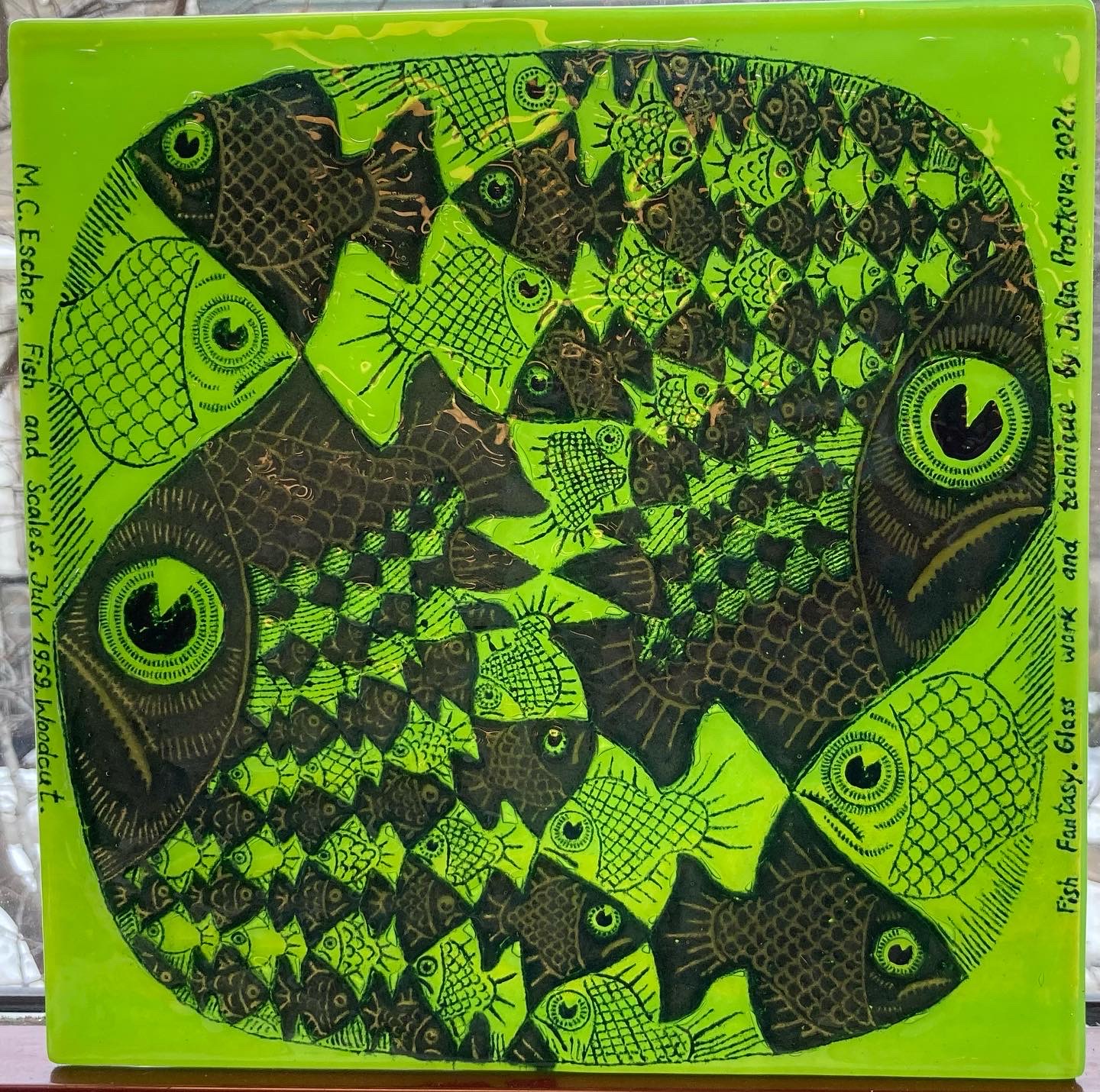
I'll start my story about the works of 2022 with the Fish Fantasy project. It is a recreation in glass of M.C. Escher's woodcut titled "Fish and Scales," from 1959. Maurits Cornelis Escher is my Inspiration. I admire his Talent and Mastery. It's not just admiration; I want to train myself to reach a similar level of expertise. How to do that? It requires following the path of the artist M.C. Escher precisely and meticulously. In 2022, I completed two works inspired by M.C. Escher.


When I create my glass recreations – and in my collection, there are already five Van Goghs in my interpretation, five Dürers in my interpretation, three Kusamas in my interpretation, and now, two Eschers in my interpretation – I assure you, I understand the Responsibility that comes with such projects. I put my heart into it. For me, these works are like conquering peaks for a mountaineer. But I am deeply convinced that my coloured glass breathes new life into these masterpieces.

So, Fish Fantasy. It turned out to be a very refined piece of work. I made an effort to capture every dot and line. Beautiful artistic glass.
And here's another piece - my interpretation of M.C. Escher's woodcut "Stars," created in 1948. While Escher was primarily interested in spatial geometry, my focus was on... Love. This work is dedicated to my reflections on love, believe it or not. Let me explain. First, I'll show you the text written on the artwork:

This work is called Chameleon Love. It is a recreation in glass of the woodcut "Stars" by M.C. Escher (October 1948). I changed the color scheme of the work to highlight my idea. For me, this work is about the love of two beings who are close in spirit and able to adapt to each other's characteristics in such a way that they can coexist in a narrow space. Glass work and technique by Julia Protkova. 2022.

Now, let's take a look at the chameleons. At the top is a red-green female chameleon, and at the bottom is a green-red male chameleon. Each chameleon has the colors of the other. They complement each other, they are both similar and different at the same time. 
I've created a slideshow during the process of working on the Chameleon Love. It's very interesting, and I recommend taking a look.

Now I'll show you three works created using medium sized frit. I want to emphasize that working with glass powder and working with glass frit are two significantly different processes. In 2022, I created three works using medium-sized frit. The first one is called Irises 2022. I recreated Van Gogh's Irises, painted by him in 1889, using frit. For me, this is the second recreation of Irises. My first work, titled "Irises. Inspired by Van Gogh", was done in 2018. Through that piece, I climbed out of a prolonged, very heavy, four-year depression. You can find the story about that work in my blog here. Several years later, in 2022, I decided to repeat Irises using a different technique to gain a deeper understanding of my inner state. Van Gogh was bipolar, and I share the same diagnosis. I feel like I hear him very delicately.

Working with frit is fascinating. Notice the beautiful shimmering effect that appeared in the Irises.

The next piece I'd like to showcase is called My Caprice I was working on a morally challenging project called "Eyes of Depression" - it was emotionally difficult, and I was reliving those years of darkness. Suddenly, I got fed up with it all. I took glass frit and decided to create something on a whim. As a result, this work incorporates many hidden experimental and future ideas. 


After creating "My Caprice," I got into the swing of things and made Caprice #2. In this piece, I incorporated several dozen experiments that I had been contemplating for several years but hadn't had the chance to bring to fruition.

The trip to Spain, specifically to Andalusia, in March at the beginning of spring, was a monumental event for me in 2022. It was absolutely amazing. I had been dreaming about it for fifteen years. Upon arrival, I created Symphony #2 on the spot, but unfortunately, it exploded in the kiln. I was a bit disappointed but still decided to make a souvenir for myself and created a project I named Flamenco by Julia Protkova. The idea is that I am the one dancing flamenco.

I took the silhouette of a flamenco dancer and replaced the face with a red spot. The grey, coarse glass frit is meant to reflect, in my opinion, the intense rhythm of the dance and the sound of the heels tapping, while the multicoloured lines represent the swirling flounces of the skirt. A fan is held in hand. So, what does the red spot instead of a face signify? I'll tell you. It represents me being out of breath, blushing, and barely breathing from the fiery dance.


The next piece I'll share is created using glass powder and is titled Eyes of Depression. Here's what I wrote on this artwork:

This work is called Eyes of Depression. This is a recreation in glass of the grotesque by Daniel Hopfer (ca. 1515-1520). I changed the color scheme of the original.This work is meant to remember the darkest period of my life - four years of endless depression. I did not know how to live my life after being diagnosed with bipolar disorder. I lost myself. I became afraid of people. I had to relearn how to live. Glass work and technique by bipolar artist Julia Protkova. May-June 2022.

The thing is, I had already made this drawing in 2014, and it turned out to be a very striking set of two plates, which I shared here. But for me, the turning point between a normal life and a life on disability due to bipolar disorder was the end of 2014. In other words, one work was made BEFORE, and the other AFTER. When I fired the Eyes of Depression, they turned out to be not as striking as the previous work done in 2014.


The next artwork is the Impromptu Vase. I did all the color work in glass, and Rock Laplante  fused it to create the vase.


The work Prayer is a conceptual work. It was conceived suddenly and created in September 2022. The prayer is addressed to God the Geometer - the Creator of the Worlds. I often turn to God in my works. I have no doubt that there is a Supreme Intelligence in the Universe. I am convinced that we know very little about the world around us.

The work Prayer has undergone numerous changes in ideas and design, and as a result turned into a piece of the starry sky. This work is not like any of my other works, although I have created several works with starry skies.

Despite the randomly scattered constellations, there is a Higher Order here. It is not visible, I deliberately hid it, but it is there. There are Beacon Stars here that form the structure and Curtain Stars that hide the structure. There is a movie on my YouTube channel on how I created this work.

At the end of 2022, around Christmas, I visited the Corning Museum of Glass. While there, I also purchased tickets to try my hand at working with glass sculpting, creating four glass flowers. I named my project Little Scarlet Flower in honour of the Russian fairy tale written by S. Aksakov in 1854-56. I worked under the guidance of professionals and enjoyed this new form of expression in glass. The flowers were gifted to my mom, son, and sister. And one for myself). 


Sunday, 29 December 2019

2019: Results of the Year

The year 2019 was the first creative year after four years of depression. I finally started to feel pleasure from creating with glass again. I am quite pleased with what I have created this year, so allow me to present you with the results. If you do not see the logic between these works, do not worry about it. Most importantly, I see it. This year is special because I started to experiment with glass once again. For those interested, the results of the first 15 years of my artistic career with glass and my story can be found here

Starry Night (story here). I for the first time worked with medium sized frit. The town below is done with glass powder. 
Homo Explorer (story here). It is a continuation of my work with regards to drawing with glass powder. I am quite pleased with this work. It is a very beautiful glass work. 
Sun. Stained glass. Sun, is a translation from arabic of the word “shamsa”. That is the name of the illuminated 1338 Koran decoration which is covered in gold leaf and painted pigments. It can be found in the library of Dublin, you can see it here. Both the original picture and my work are not symmetrical but close to it. I wanted to see how it would look in stained glass. I am pleased with this work. 
Ornamental Cat. Unfortunately, this work blew up in the kiln. I worked a fairly long time on it. When I saw this self-portrait of Yayoi Kusama, it shook me to the depth of my soul. 
This cat is a projection of my admiration for her. Kusama-san, is a female artist with a mental disorder. She is the richest of all female artists in the world. She is 90 years old and she works daily in her workshop. She is my role model. I decided to show you my non-fused work to illustrate how beautiful it is. It pains me that it did not work out. It was supposed to be my finest work yet. I hope to someday recreate it again. 
Flying Ship. I, with great pleasure, have made another sailing ship. The last time I made a sailing ship was in 2005. It was a long time ago… two lifetimes ago. I wanted to re-experience that feeling of making the sailing ship again. I really like sailing ships. This time, it is flying from night to day towards the sun. This time around, I worked under the wing of a professional. Rock Laplante came up with the idea of the lines in the background. I had a completely different idea from his, but I am very satisfied with how this work turned out. I managed to retain the pattern in the glass for the background. 
Road of Pilgrim (story here). I am continuing the experiments with the technique of drawing with glass powder. This time around I made non-repeating brush strokes, essentially a complex ornament. I have never done this before. I wanted to reach a point where on the painting everything is in motion, a star flickers, an angel flies in the sky, shrubs and cypress sway and the road runs. If you take a step back from the monitor, you will better see the movement. I felt very free when applying these brush strokes. In this work, there is a whole lot of me. 
Medieval Town. I really love making these works. In my blog, I have a full post about medieval towns (only in russian) here. It takes a really fine hand; it is truly the creation of a miniature. I work with a thin needle and practically count the particles of powder to create these thin lines. This is my test to see how well my hands work. I am showing the work in progress. This town will be laid upon beautiful pink glass. I am very satisfied with the thickness of the lines; they are even finer than in my work Homo Explorer. The work should turn out as fine as lace. Showing the status as of today.


Road of Pilgrim. 2019. 27 x 33 cm.

I, with great pleasure, would like to show you my latest work. It is called the Road of Pilgrim and it is inspired by Van Gogh’s, Road with Cypress and Star. This time I will try not to mix lyrics with technique and I will write two separate parts. The lyrical part is for those interested in the thoughts of the artist. The technical part is for those interested in the details behind the making of the piece.

 Lyrical Part.
The Road of Pilgrim is a logical continuation of my previous work called Homo Explorer (story here). I will remind you that Homo Explorer, is about a pilgrim who saw and heard the Unknown. He walked to the edge of the earth, found a loophole in the fabric of reality and took a glance at the Universe. Here I thought to myself, that the Road of Pilgrim is about the pilgrim returning from a meeting with the Unknown. He will be meeting with people on the road, telling of the things he has seen. What will he tell the others? Will he be able to convey his feelings, emotions and new vision? It has always concerned me how knowledge is passed on. What should I believe? Who should I believe? How do we see? How do we understand what we are told? Finally, since everyone sees the world through their own perspective, it is truly difficult to convey something without distortion. 

 Take a look at my work. It is different from the original, that is obvious. It is a portrayal of my vision of the original work. This is how I see it, do you understand? It is incredibly interesting to me. At some point in time, I was examining a photo of my finished work and was disappointed to see that it looked like a child’s drawing; naive art. I was flustered. I started to analyze how I went about creating this piece. I tried really hard. It was the first time I used this brush stroke texture. But the work is very dynamic. Try to play with the picture by looking at it closer or farther away from the monitor. You will see the effect of movement, which is exactly what I was trying to convey. I personally see it loud and clear. If you catch the desired focus point - everything is moving. A star flickers, an angel flies in the sky, shrubs and cypress sway and the road runs. 

 Why did I choose this work? For the effect of movement and the road. I feel as if I am a pilgrim on the road attempting to talk about the beauty of the world. I am meeting people on the way. Some are interested in what I have to say while others do not care. That is normal. The road itself awakens within me a sense of anticipation new, new meetings and new places. I love this feeling. I love the road. This work is a tribute to people who feel they are on their paths. May the guiding star always shine on you. 

This is my third work based off of Van Gogh’s paintings. Firstly I created Irises in December 2018 (story here), next came Starry Night in January 2019 (story here), and now my Road of Pilgrim. I think a lot about Van Gogh. He interests me very much. For those who read my blog, you know that I am a self-taught artist with bipolar disorder. My vision and understanding of Van Gogh as an artist with bipolar disorder is my own. I understand his passion for creation. I too, also dream of creating art day and night. I am grateful for the opportunity to create glass, and develop myself further as an artist. For those interested in what I have created this year (2019), there is a post, 2019: Results of the Year (here). 

I created a picture for comparison. What do I want to show with this picture? I am satisfied with the colour scheme that I chose for this piece. You see two different works on the same subject. Two different human visions. You know, researchers say that Van Gogh thought about death when creating this painting. I do not know. But I can tell you what I was thinking about. For me, it is a life-affirming work. The understanding that I am going and moving forward. Thank God I can continue to create my glass and further develop myself. During the time that I worked on Road of Pilgrim I formulated for myself my future steps. 
I created my technique of drawing with glass powder for the opportunity to create my favourite pictures in glass with maximum accuracy. In this work, I enjoyed the freedom of not having to draw accurately. I like how it turned out. I really like how the texture of this piece turned out. 

What ideas am I trying to convey? For the first time, I allowed myself some freedom in the design. I applied brush strokes of glass powder as I felt. There was no incentive to draw with precision, it was also not possible because of the difference in medium. I feel like I have progressed a step further in developing my own artistic style. 

Technical Part. 
I want to show you how I go about my work. I explain the basics of my technique here

First of all, I have never done such a texture with glass powder before. I call this texture a complex ornament. This is my first attempt, first experiment, 91 hours of work and a total of 5 firings. 

What is the texture of a complex ornament? It is the alternation between different colours of glass powder. A simple ornament would have a basic pattern such as ABABAB. A complex ornament on the other hand would have a more intricate pattern such as ABACABABAC, ABCABC or any other combination up to ten colours. 


I worked with five to ten colours at a time. The road for example is comprised of ten different colours. Each colour has its own brush to avoid any contamination with different colours. Of course, you can make do with one brush and wash it after every brush stroke… but it is more comfortable with ten brushes. Here the photo shows six colours ready to be used. To the left of the work, you see six containers with glass powder with a brush in each one. 
If you take a look at the slide show (here), the first picture shows how I drew on different areas of the piece. I would start on the sky, then the road, then the shrubs. After I have worked on different areas of the piece, the work was fused for the first time. After seeing the result of the first fusing, I increased the density of the brush strokes a tad. Finally, in one centimeter I had 4.5 brush strokes. This is a fairly fine work, let me tell you. In total, it took 91 hours to complete. I calculated that I could draw up to nine square centimeters per hour. In the slide show, the pictures are taken approximately every five hours. 

It is very important to keep track of the viscosity of the glass powder paste. More than anything, it needs to be of a similar consistency for all glass powders. I myself eyeball the viscosity, but the point is clear. If you have a paste that is too liquidy while another is too thick, and you place them next to one another, after fusing the liquidy paste will disappear to reveal holes in the work. For this piece I used a thick paste. Very thick, very very thick sour cream. This picture was made after the first fusing, as you can see, there are many holes. As a result, I increased the thickness of the paste and the density of the brush strokes. What to do with the holes? Fill them up with a new layer of paste. 
Just as well, I kept track of which powder colours I used. I only work with Bullseye glass.
Why did I need five firings? Technically, you can make do with two. First, to understand the colours and the density of the brush strokes. And the second, for the final fusing. But I had the opportunity to do intermediate fusings, it was interesting to see how the colours of the powders changed. 
I also enjoy seeing the backside of the piece. Moreover, I sign my work with glass powder of the reverse side.


Sunday, 3 February 2019

Starry Night. January 2019. 37 x 30 cm.

So, a month after the completion of Irises (you can find the story here), I have created and am gladly presenting to you my new work. Starry Night. January 2019. 37 x 30 cm.

 The original Starry Night was painted in June 1889 and is in MOMA, New York. Moreover, it is known from Van Gogh’s letters that he was not happy with Starry Night.

 You know, Van Gogh liked to copy and compared it with music and would find consolation in copying other works of art (letter to Theo of September 20, 1889).

 I thought of what Van Gogh would say when he looked at my copy of his work. When such an idea comes to mind, you are trying hard to show off. I was doing my best and I always do my best while working with glass.

 First, glass is a completely different material. Glass frit and glass powder. You have your palette of colours, but it can not be mixed together. Moreover, I confidently began to make a Starry Night out of material I never worked with - from medium sized frit. At first I thought it would not work. Then with a new technique I completed my version of Starry Night in 25 hours.

 Secondly, it is absolutely clear to me how to create this work by painting with glass powder (the description of the technique can be found here). Furthermore, I drew the village in Starry Night with glass powder. If I were to use medium-grained frit, I could not achieve such accuracy. The houses, fields and frontal trees were created with powder while the sky, stars, mountains and gardens of trees was made with medium sized frit.

 I made comparison pictures to compare the two Starry Nights side by side.


 Thirdly, I will be happy to show you my rhythm and my steps as I was creating the work. Here in this order was the progression of my starry night.


After final fusing.

 What did Van Gogh think when he painted this picture? There are thousands of interpretations. What did I think when I worked on this picture? About Van Gogh. I read his letters, read the two-volume book of the 2010 Taschen Complete Collection of Paintings. My son presented me this book for the New Year in 2012. I also thought about how my vision of Van Gogh is completely different now ... In 2012, I did not know how to approach when creating such a piece with glass. And now I pretty quickly managed to make Starry Night using techniques invented by me.

 Here is the article about the Starry Night and 10 facts that you did not know about the Starry Night by Van Gogh. There is something to think about. Van Gogh considered this work a failure. And he wrote the view from the east window 21 times, but he never wrote a grille on the windows.

 I want to quote from Van Gogh. He writes to Brother Theo on July 10, 1888
"But the sight of the stars always makes me dream in as simple a way as the black spots on the map, representing towns and villages, make me dream.
Why, I say to myself, should the spots of light in the firmament be less accessible to us than the black spots on the map of France.
Just as we take the train to go to Tarascon or Rouen, we take death to go to a star.20 What’s certainly true in this argument is that while alive, we cannot go to a star, any more than once dead we’d be able to take the train. So it seems to me not impossible that cholera, the stone, consumption, cancer are celestial means of locomotion, just as steamboats, omnibuses and the railway are terrestrial ones.
To die peacefully of old age would be to go there on foot."

Sunday, 30 December 2018

Irises, inspired by Van Gogh. 2018. 29 x 35 cm


The idea to create Irises came to my head ten years ago. But up until now, it was never technically possible. I would never bring myself to do this if I did not feel I had the strength to accomplish it. This is a difficult work. It has a living character and I need to convey this character. I need the Irises to look beautiful in glass. 

For me this work is a test of my capabilities when working with glass. Experiment. Can I convey a painting through glass? I have already been successful in representing icons, a tapestry and manuscripts with glass, can I accomplish the same with a painting? The glass gives off its own charm with this work, it looks beautiful when you look at it and when you touch it. With my glass art, I have been progressively creating more and more difficult pieces (take a look at the post called 15 Years of Creativity in Glass here). However, this project in particular was still quite an ambitious undertaking from my point of view. 

 Irises for me meant a new frontier. A definite checkpoint in my life’s path. My glass returned me to life after four years of heavy depression. I am saying this without any pathos. I also think of Irises as a work in which I pursue a bipolar study. I chose Van Gogh because he too suffered from bipolar disorder. I was diagnosed with bipolar disorder in December 2014 and since then I have been suffering from heavy depression. However, Irises captured my heart and soul so fully that I kept thinking about them every day. I was once again inspired. And so I came back to life. 

 Of course I thought about Van Gogh and of myself. I thought about how he lived at in an asylum and within a year managed to paint over 130 works of art and how Irises was his very first work during his time there. An artist needs to have the possibility to create, everything else becomes secondary. I have the opportunity to fuse my glass and to work on my own projects. I am very grateful for this opportunity. I thought about how it took Van Gogh only 2-3 days to paint Irises and how satisfied he was with them, very satisfied. My process of making Irises stretched out over half a year, counting two months of summer break where I did not work on glass at all. It took me a total of seventy hours to finish Irises. I am satisfied with my Irises, very satisfied. Now it is going to be more fun, I plan to dedicate more time to my glass. I am interested once more. 

I have already written that you can take my works and feel them with your hands. For myself as a kinesthetic, this is critical. My works are very tangible. They possess a weight, a thickness, a surface texture of lines, brush strokes, dots and flowers. It is very pleasant to touch them. I wanted the opportunity to touch Van Gogh’s Irises. Van Gogh’s Irises served as a model for my Irises. 
 What can I say? First I created all the leaves of the Irises. I followed Van Gogh’s brush strokes when I placed my glass powder. Unfortunately, I was limited in terms of my colour choice and unlike with paint, you cannot really mix the glass powders together to create a new colour. This meant that the leaves were created with five different shades. Next, I gathered myself up and set to work on the irises. They also possessed around 5-6 different shades of glass powders. There was one colour which I did not use and it was dark cobalt blue. I decided that if I were to use it, the Irises would turn out to be artificially blue. The idea of darker irises was ok with me. 
 After completing the leaves and some irises in the piece, the work was fused. I have never done this before where I fuse in the middle of the process, but I very much wanted to see how it would look. Once I saw my lively Irises, I was filled with joy. My Irises were significantly darker than the original. The colours by the names of aventurine blue and midnight blue practically became indistinguishable but I did not have the appropriate blue that I needed. By the way, the incomplete version of Irises that you see below on its own is not such a bad painting and idea. 
 How did I choose my colours? I had a palette of glass powder that I worked with. I knew off the bat that I would not be able to achieve Van Gogh’s colours, I work with an entirely different technique, with an entirely different material and with a strict colour scale. But I decided for myself a certain colour code and I held to it. 
 There was already some movement and rhythm within my work, thus I continued. On this photo you can see my fused irises, the fused ones are a darker shade and on the right while the unfused ones are of a lighter shade on the left. This is how they change colour when fused. At the same time, you can see the amount of paintbrushes, needles and painting knives that I work with. 
 I worked on the top part of my Irises. I made a bright green and light green field with some white, yellow and orange. 
I was eager to see how they would look again after fusing. And so, the Irises were fused a second time. What did I see? I saw the the lettuce green colour that I put in the top right corner turned out darker than I expected. So stubborn is my glass that it decided to incorporate its own outlook into my work. I came to like this outlook. I suspect that it was a reaction of the glass on a low temperature profile. But a higher temperature profile I did not want because I would lose the very beautiful relief in the work and the feeling of the brush stroke and all that would remain is just a flat surface. 
After the second fusing, I just filled in the blank areas. Where Van Gogh was just filling in the space, I also coloured automatically. Where Van Gogh had details, I would also add details. 
In the top part of Irises, I had some space left. Initially I wrote a full text. I love writing texts on my works. I wrote in English with the help of glass powder “Is it possible to create a painting in glass? This study uses Irises by Van Gogh as a model. This is made using fused glass powder. Julia Protkova. 2018”. 

Afterwards, I erased all the writings with the help of a wet rag and simply wrote “Irises. Inspired by Van Gogh. Glass work by Julia Protkova. 2018.” 

Finally, the Irises were fused for the third time. Thus, my Irises were ready at last. A complex piece. Probably the best work I have done thus far with fusing.

Glass powder technique described here.